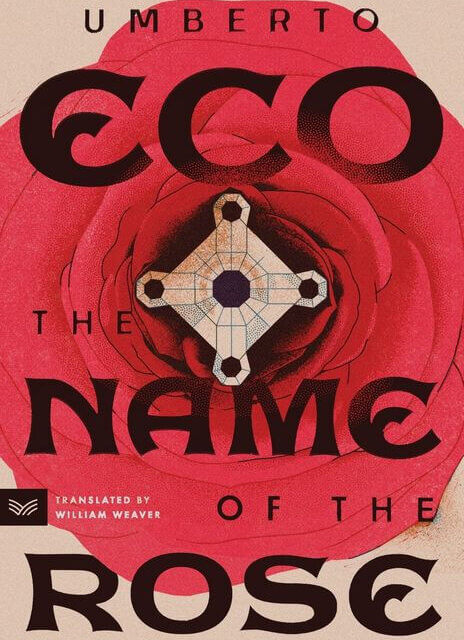
I read The Name of the Rose (Il nome della rosa) in Italian when it was first released in Italy back in 1980. For someone who was only fluent in conversational Italian, it was a tough go, so when it was released in translation in 1983, I read it again and loved it once again. Having recently read Laurus by Eugene Vodolazkin, purported to be the Russian equivalent, I decided to reread The Name of the Rose for the third time.
This is a murder mystery set in an Italian monastery in 1327. The monastery contains a rare treasure trove on ancient books and documents held in a huge labyrinthine library. A Franciscan monk, William of Baskerville arrives with his novice, Adso (the narrator), arrive at a Benedictine abbey just ahead of Pope John XXII and Bernardo Gui (an inquisitor) who are meeting to discuss apostolic poverty and heresy. The night before William’s arrival, a series of murders begins which seem to correspond to the seven trumpets described in the Book of Revelation.
William is very contemporary in his thought process and uses Aristole’s logic, Thomas Aquinas’s theology, and Roger Bacon’s empiricism to solve the crimes. With these tools he decodes manuscripts, collects evidence, explores the monastery’s enormous library, and solves the mysterious deaths.
If you enjoy books with lots of delightful, sophisticated words to look up in the dictionary and books that combine history, religion, philosophy, and humanism, you’ll enjoy this book. If you don’t enjoy passages of untranslated Latin or treatises on heresy in its many medieval forms, you won’t enjoy this.
 If you liked this book, but would like to read something similar but less “deep” (and shorter) you might look at Ellis Peters’s Brother Cadfael mysteries (I’ve read the entire series). Cadfael lives in 12th century at the Abbey Church of Saint Peter and Saint Paul, in Shropshire, England. A former soldier and sailor, Cadfael, like William of Baskerville, is curious, a skillful observer of the human condition, a healer/herbalist, and walks a fine line between the secular and the sacred worlds of the monastery while solving mysteries.
********************
The Name of the Rose (HarperVia, September 28, 1994) is available through:
Your local independent bookseller | Amazon | Barnes & Noble
********************
This post contains affiliate links to third party sites. These can help you visually identify books I recommend. If you make a purchase, I may receive a small compensation at no additional cost to you. This offsets some of the cost of maintaining this blog.